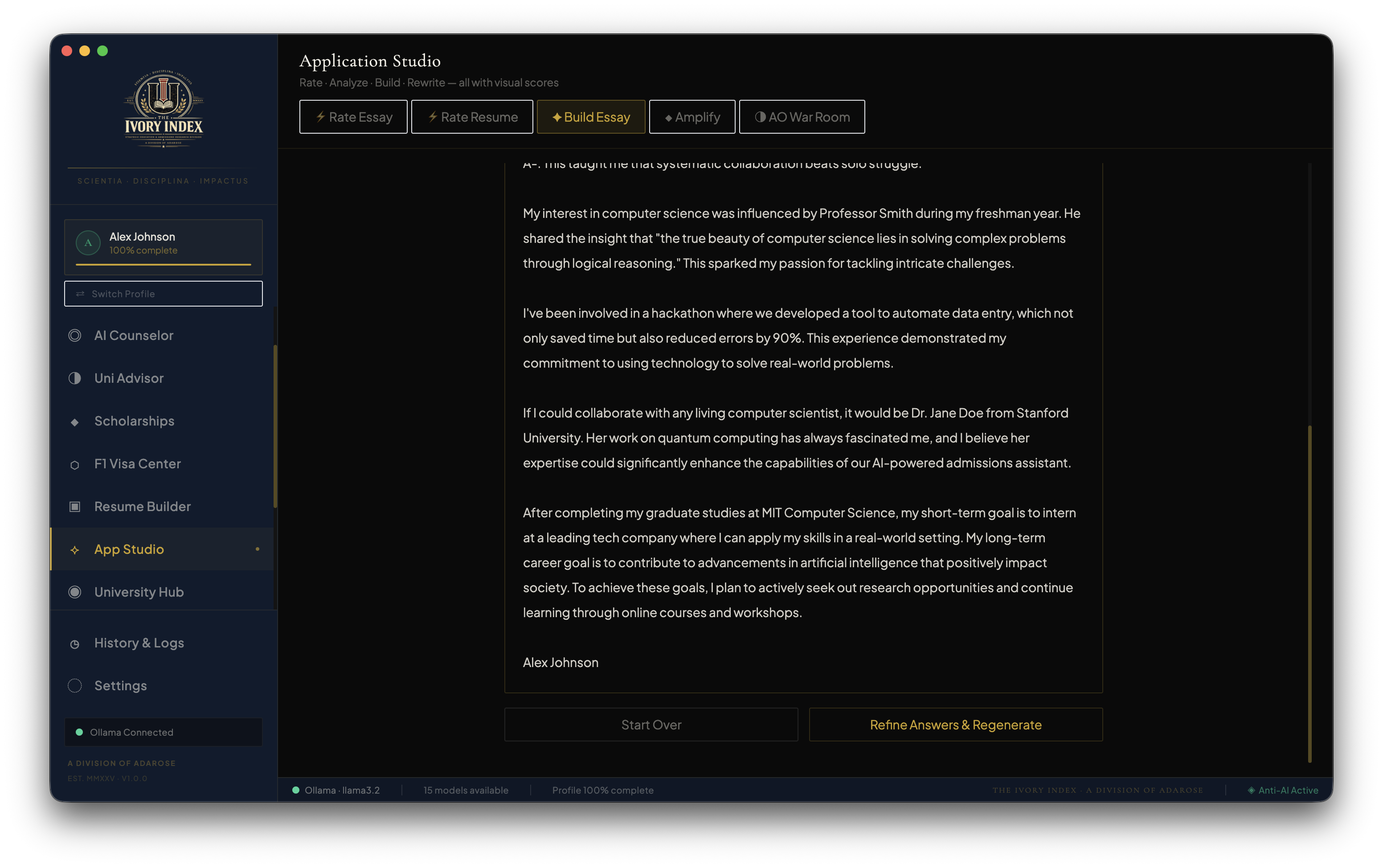
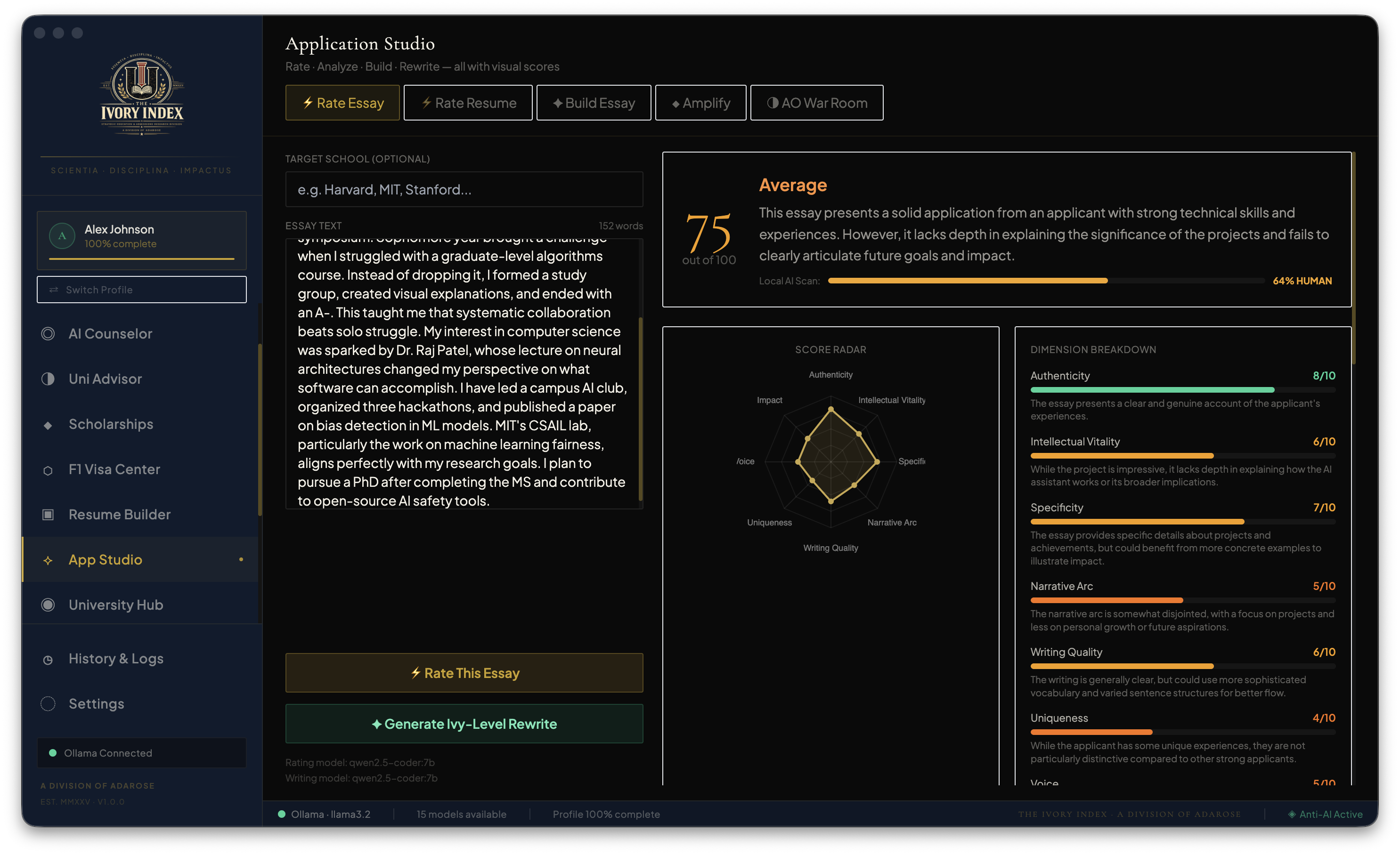
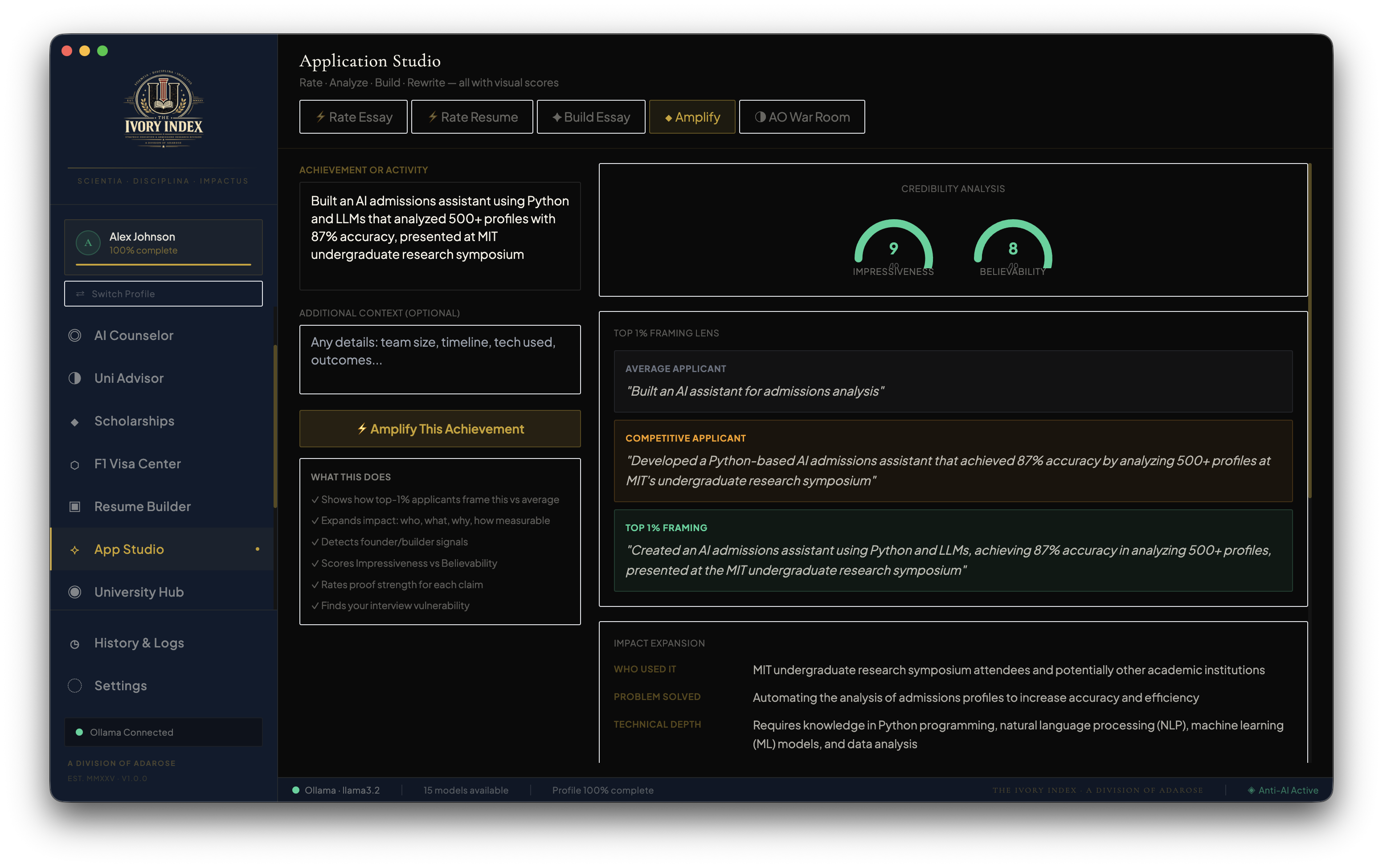
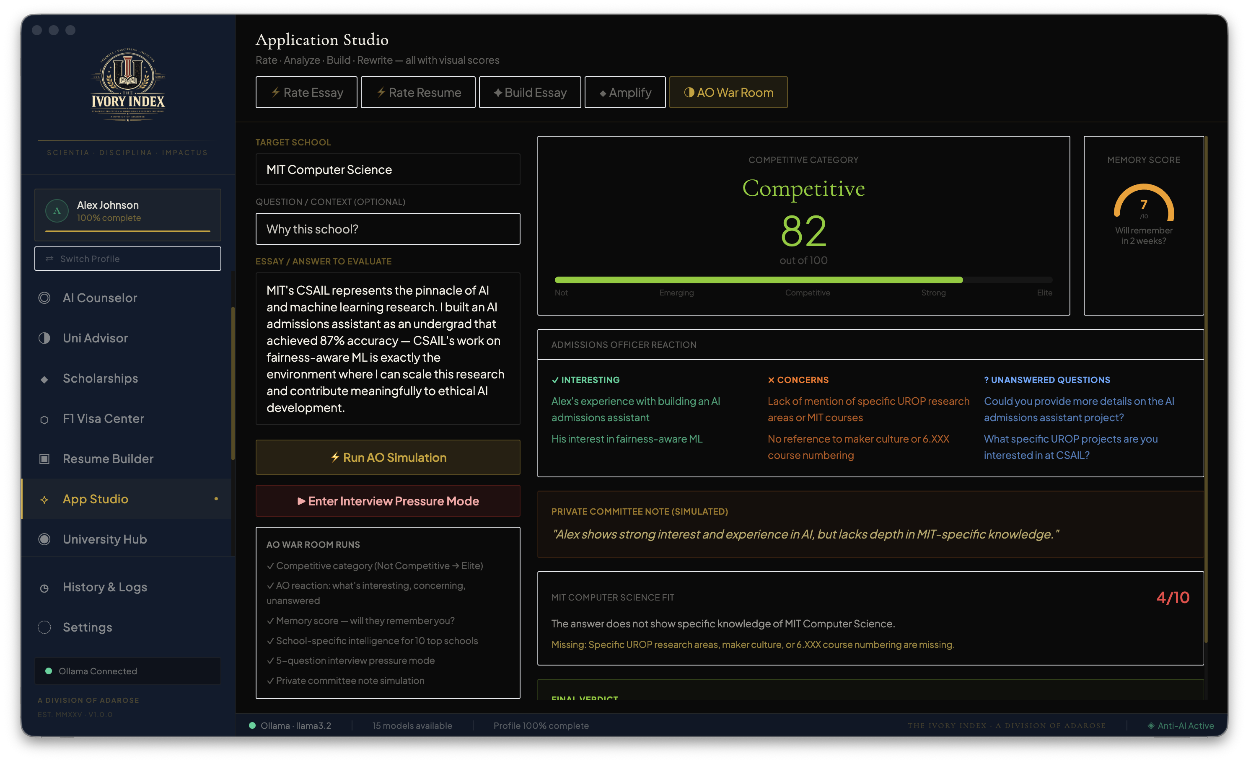
OPEN ACCESS // SEARD HANDBOOK DIRECTIVE
THE IVORY INDEX Logo

THE IVORY INDEX

Strategic Education & Admissions Research Division

Governed under Imperial Eminence Cyberguard Corporation

PURPOSE DIRECTIVE: This index serves as a strategic manual designed to dismantle the operational complexity, marketing myths, and emotional anxiety of the United States higher education admissions ecosystem.

Executive Summary

The higher education landscape in the United States functions as one of the most complex, high-stakes matching markets in the world. For decades, the structural dynamics of this ecosystem have been intentionally obscured by institutional public relations, commercial rankings, and a lucrative "admissions consulting" cartel that thrives on applicant confusion.

This handbook is compiled by independent researchers to serve as an objective, practical operational manual. Our core philosophy is to replace anxiety with analytical clarity, exposing common profile scams, outlining structural realities, and explaining step-by-step how to construct an authentic, competitive application without relying on predatory, hyper-priced consultancy agencies.

"The frightened mind sees a maze; the informed mind begins noticing doors."
Part I

Understanding the US Education System

The higher education architecture in the United States is decentralized, credit-based, and modular. Unlike national systems governed by a central ministry of education (such as India's MHRD or the UK's Department for Education), the US system has no single national standard [1]. This flexibility is its greatest strength, but it also introduces immense navigational complexity.

1. Institutional Taxonomies

To accurately evaluate where you fit, you must map universities not by their commercial marketing brochures, but by their structural, funding, and operational designs:

Public Universities & State Flagships

Large, state-funded institutions (e.g., UC Berkeley, UT Austin, University of Michigan). They prioritize state residents, maintain large class sizes, but offer massive alumni networks, immense public research funds, and lower tuition rates for in-state citizens [2].

Private Universities

Endowment-funded institutions (e.g., Stanford, Vanderbilt, USC). They charge the same tuition regardless of your home state, offer smaller average class sizes, and frequently possess substantial private financial aid packages for qualified domestic and international applicants.

Liberal Arts Colleges (LACs)

Undergraduate-only focused private colleges (e.g., Williams, Amherst, Swarthmore). They emphasize the humanities, writing instruction, small interactive seminars, and offer direct research access with senior professors without competition from graduate PhD students.

The 2+2 Community College Pathway

Two-year public colleges offering Associate Degrees. Through formal "Articulation Agreements," students can complete general education requirements at extremely low tuition costs and transfer seamlessly to complete their bachelor's degree at premier public universities (e.g., transferring from Santa Monica College to UCLA), saving up to $80,000 in total educational expenses [3].

Honors Colleges

Dedicated academies housed within large public flagships (e.g., Barrett Honors at ASU). They provide the best of both worlds: the small-scale, prioritized seminar-style learning of an LAC, combined with the extensive sports, labs, and career recruitment platforms of a massive research university.

2. The Ivy League: Demystified

The term "Ivy League" does not refer to an academic ranking. It is an athletic conference formed in 1954 comprising eight private schools in the Northeastern United States. Many of the most academically selective institutions in the world—such as MIT, Stanford, Caltech, Duke, and UChicago—are not members of the Ivy League.

University Formidable Academic Strengths Admissions Selectivity Trend (Class of 2028) [4]
Harvard University Neuroscience, Government, Economics, History of Science ~3.59% Acceptance Rate
Yale University Global Affairs, English, Theater & Performance, Political Science ~3.73% Acceptance Rate
Princeton University Mathematics, Physics, Public Policy, Classics (Senior Thesis required) ~4.50% Acceptance Rate (Est.)
Columbia University Computational Social Sciences, Physics, Journalism, Philosophy ~3.85% Acceptance Rate
University of Pennsylvania Wharton Business, Nursing, Bioengineering, Cognitive Science ~5.40% Acceptance Rate
Brown University Open Curriculum: Applied Math, Economics, Modern Culture & Media ~5.16% Acceptance Rate
Dartmouth College Quantitative Social Science, Engineering Sciences, Environmental Studies ~5.30% Acceptance Rate
Cornell University Architecture, Hotel Administration, Space Sciences, Computer Science ~7.90% Acceptance Rate (Est.)

3. Need-Blind vs. Need-Aware Financial Policies

Understanding institutional financial policy is a survival skill for international students:

  • Need-Blind: The admissions committee reviews your profile without looking at your financial aid request. If you are admitted, they guarantee to meet 100% of your family's demonstrated financial need.
    As of 2026, only seven institutions in the US offer true Need-Blind Admissions for International Applicants: Harvard, Yale, Princeton, MIT, Amherst, Dartmouth, and Bowdoin [5].
  • Need-Aware: The school's financial aid department is integrated with the admissions team. If your profile is highly competitive but you require substantial financial assistance, your need for aid will mathematically lower your probability of admission in a competitive pool.

4. Navigating Application Timelines

The time of year you apply changes the statistical parameters of the game:

Timeline Category Deadline Date Rules & Tactical Trade-offs
Early Decision (ED I / II) Nov 1 / Jan 1 Binding Commitment: You can apply to only one ED school. If accepted, you must withdraw all other applications and enroll immediately. Highly strategic for optimizing "Yield Rates" (the percent of accepted students who enroll). Often doubles your statistical chance of entry.
Early Action (EA) Nov 1 / Nov 15 Non-Binding: You apply early and receive an early decision, but are under no obligation to commit until May 1. Excellent for comparing financial aid packages across public and target private schools.
Restrictive Early Action (REA) Nov 1 Non-Binding restriction: Also called Single-Choice Early Action (SCEA). You cannot apply early to any other private university in the US, but you remain free to apply to public universities. Used by Stanford, Harvard, Yale, Princeton, and Notre Dame.
Regular Decision (RD) Jan 1 - Jan 15 Standard Pool: Non-binding, decisions released in late March. This pool is by far the largest, most competitive, and holds the lowest statistical acceptance rates.

5. Holistic Admissions: The Selective Funnel

Unlike academic systems in countries like India, China, or South Korea, which rank applicants linearly based on a single high-stakes entrance examination (such as the JEE or Gaokao), US admissions committees evaluate candidates holistically. Admissions officers are not cold, algorithmic robots; they are human readers, working in committees, balancing fluid institutional targets, budget limits, and class composition priorities.

They evaluate applicants through a selective, multi-stage funnel designed to screen academic competence before evaluating individual character, perspective, and community fit:

The Holistic Admissions Funnel
STAGE 1: THE ACADEMIC FLOOR (GPA & Course Rigor Check)

Filters out candidates unable to handle the academic load. GPA, school rank, and standardized test scores are verified.

STAGE 2: QUANTIFIED IMPACT (Extracurricular & Rec Letters)

Evaluates what you did outside the classroom. Verifies leadership scale, spike achievements, and teacher observations.

STAGE 3: NARRATIVE INTEGRITY (Personal Voice & Essays)

Examines core values, maturity, and intellectual curiosity. Assesses authenticity and checks for formulaic/AI indicators.

STAGE 4: THE COMMITTEE MATCH (Institutional Fit)

Final select stage. Evaluates matching coordinates: geographic representation, major diversity, and specialized talents.

Academic Threshold (The Floor)

A composite evaluation of GPA, course difficulty, and SAT/ACT scores. This is not used to secure admission, but to establish academic capability. If your marks fall below the institutional floor, your application is filtered out. Having a perfect score above the floor does not guarantee entry; it merely moves your folder to the next stage.

Institutional Match (The Ceiling)

The character and narrative assessment of the folder. What special skill, background, perspective, or unique interest do you possess that matches a vacancy on the campus? Are you a world-class musician? A student body president who managed real community disputes? This is where the application is won or lost.

Part II

Building a Strong Profile

A competitive profile is a cohesive, strategic narrative. It is built upon a solid academic foundation and crowned with a clear, highly concentrated extracurricular "spike."

1. The Academic Core

Your academic transcript is the core pillar of your application. Admissions committees examine this document closely to evaluate three major variables:

  • Academic Rigor: Did you take the most challenging courses available at your school? Taking the hardest classes (such as AP, IB Diploma, or A-Levels) and scoring a B+ or A- is historically viewed much more favorably by top committees than taking easy classes just to protect a perfect, unweighted A+ average [6].
  • Grade Trends: A positive trajectory matters. If you had a difficult transition in Grade 9 but showed consistent upward growth in Grades 10, 11, and 12, admissions committees recognize this resilience. A downward trend, however, is a severe concern.
  • Global Board Calibration: Admissions systems understand international systems. The International Baccalaureate (IB) and Cambridge A-Levels are highly respected for independent research components. National boards like India's CBSE or ISC are respected for quantitative depth; therefore, students from these systems should ideally secure high SAT/ACT scores to validate their critical thinking skills globally.

2. Standardized Testing Nuance Matrix

The rise of the "Test-Optional" movement has created widespread confusion. What does it actually mean for competitive admissions? Rather than treating scores as a simple binary, successful candidates evaluate testing requirements through an institutional lens:

Standardized Testing Policy Nuance Matrix
1. TEST-REQUIRED

Institutions: MIT, Yale, Dartmouth, Brown, Caltech, UT Austin.

Scores are mandatory. Re-established by elite schools to validate academic thresholds amidst widespread high school grade inflation [7].

2. TEST-OPTIONAL

Institutions: Harvard, Stanford, Columbia, Chicago, Williams.

For highly selective STEM admissions or international candidates requiring aid, strong test scores still provide a major competitive advantage.

3. TEST-BLIND / FREE

Institutions: University of California System (UCLA, Berkeley, Irvine).

Scores are completely ignored. Committees rely heavily on GPA, class rank, local context, and detailed extracurricular essays.

Test Class Optimal Target Thresholds Purpose & Tactics
Digital SAT (DSAT) [8] 1500+ (STEM: 1540+ with Math 780+) Tests adaptive Reading/Writing and Math. Excellent baseline equalizer across unknown high schools. Aim to complete prep by the end of Grade 11.
ACT 34+ out of 36 Includes a Science section and focuses heavily on speed. Highly viable alternative if you struggle with the DSAT's adaptive reading structure.
TOEFL / IELTS / DET TOEFL: 110+ | IELTS: 8.0+ | DET: 135+ Mandatory English checks for non-native speakers. Scores below these levels create communication-capability concerns.

3. The Profile Archetype Map

For decades, traditional guidance counselors advised teenagers to do "everything": play one sport, play one instrument, do debate, and volunteer at a soup kitchen for 10 hours a month. This advice is obsolete for elite admissions. Highly selective committees do not seek a well-rounded student; they seek a well-rounded class comprised of highly focused, spiked students who excel deeply in one niche.

Competitive Profile Archetype Map
THE SPECIALIST

Focus: Academic & Scientific Research

Characterized by deep subject specialization, Olympiad milestones, or co-authoring scientific papers under professor guidance.

THE BUILDER

Focus: Tech, Apps & Registered Startups

Characterized by actual open-source projects, deployed codebases with active users, hackathon wins, or registered micro-businesses.

THE ADVOCATE

Focus: Law, Policy, Ethics & Geopolitics

Characterized by debate championships, published historical analysis in selective reviews, or verified community organizing.

TIER 1
Exceptional (Global / National Apex): International Olympiad medalist (IMO, IPhO, IBO), top national award winner (Regeneron STS, ISEF finalist), founding a venture with audited, high-tier venture capital, publishing solo first-author research in a top-tier peer-reviewed journal, highly recruited Division I athlete.
TIER 2
Outstanding (State / Regional Apex): Regional Olympiad qualification (AIME/USAMO qualifier), state-level debate champion, creating an open-source software project with over 1,000 active GitHub stars, creating an NGO with audited, verified local impact (real revenue, real metrics, real regulatory registration).
TIER 3
Good (School / Community Leadership): School president, varsity captain, local volunteering coordinator, publishing in minor school/high school research journals, president of a prominent school-level club.
TIER 4
Common (Passive General Membership): General club membership with no leadership title or measurable output, general volunteering hours, completing paid "pay-to-play" university summer schools that offer automatic entry.

4. Specialized Discipline Profiles

If you wish to build an undeniable spike, you must choose an academic focus and cultivate activities that align perfectly with that focus:

Track A: Artificial Intelligence & Machine Learning

Core Objective: Prove concrete implementation, mathematical depth, and algorithmic fluency while maintaining a mature, ethical understanding of the societal impacts of computing.

  • Optimal Activities: Building and maintaining an open-source library or neural network tool on GitHub (measured by stars, forks, and pull requests). Contributing code to established open-source libraries like PyTorch, Scikit-learn, or HuggingFace. Winning regional hackathons. Qualifying for Kaggle Grandmaster status.
  • What AOs Look For: Actual programming execution. Committees dismiss profiles consisting only of "Coursera certificates in Python." They want to see working, deployed applications used by real human beings.
Track B: Cybersecurity & Systems Engineering

Core Objective: Establish technical capability in systems architecture, ethical hacking, network analysis, and structural cryptography.

  • Optimal Activities: Competing in prestigious global Capture The Flag (CTF) events (e.g., PicoCTF, DefCon CTF). Responsible disclosure of security vulnerabilities (CVE discovery, verified Bug Bounties). Building secure networking tools or custom operating system kernels. Creating educational cybersecurity tutorials or workshops in underserved public schools.
  • What AOs Look For: Real-world proof of capability. Security is a high-risk domain; showing that you have been recognized for responsible, highly-principled technical disclosure proves high character alongside exceptional ability.
Track C: Business, Finance & Entrepreneurship

Core Objective: Prove market awareness, operational resilience, and the direct capacity to generate economic value, build structures, and guide teams.

  • Optimal Activities: Founding a registered micro-business that generates verified monthly recurring revenue (MRR). Launching a regional startup pitch competition with audited sponsorship. Writing analytical investment research or equity evaluations. Leading a competitive DECA or FBLA chapter to state-level or national success.
  • What AOs Look For: Traction. Committees are skeptical of "paper clubs" that only simulate stock portfolios. They want to see real-world execution, whether it's managing a real budget, coordinating supply chains, or acquiring paying users.
Track D: Law, Policy & Geopolitics

Core Objective: Demonstrate verbal and analytical capacity, public advocacy, persuasive writing, and systemic institutional understanding.

  • Optimal Activities: Winning highly competitive regional/national speech or mock-trial competitions. Organizing regional Model United Nations conferences that tackle actual local governance issues. Publishing deeply-researched, long-form historical analysis in recognized platforms (e.g., *The Concord Review* or *The John Locke Essay Competition*). Interning directly with state legislative representatives or active civil rights legal defense organizations.
  • What AOs Look For: Clarity of thought. Committees want to see that you can synthesize complex, conflicting legal or historical perspectives and present a structured, logically defensible thesis.
Track E: Academic & Scientific Research

Core Objective: Prove independent intellectual inquiry, adherence to scientific methodology, and original contributions to human knowledge.

  • Optimal Activities: Conducting independent laboratory research under the direct mentorship of a university professor or a structured research program (e.g., RSI). Publishing original findings as a primary author in a verified, non-predatory high school journal. Presenting posters at recognized professional scientific symposiums. Winning international science and engineering challenges (e.g., ISEF).
  • What AOs Look For: Real research. Committees are trained to distinguish between independent inquiry and passive "lab-shadowing" where a student's parent used personal connections to secure them a certificate for basic cleaning tasks in a university laboratory.
Track F: Creative Arts, Literature & Design

Core Objective: Demonstrate creative vision, formal mastery of your medium, and systemic artistic risk-taking.

  • Optimal Activities: Winning highly selective national art/writing competitions (such as the Scholastic Art & Writing Gold Key). Hosting a solo physical gallery exhibition or launching an internationally recognized literary magazine. Publishing original creative writing in high-authority literary reviews. Generating a design portfolio showing industrial product prototypes or digital UI/UX solutions.
  • What AOs Look For: Structural depth. Creative applicants must submit a curated, professional-grade supplementary portfolio that shows technical refinement and a mature, self-reflective artistic philosophy.

5. Profile Inflation: Exposing the Scams

The highly competitive nature of US admissions has generated an underbelly of deceptive practices. Admissions committees are now highly trained to detect and reject these common "hollow" profiles:

The "Fake" NGO Scam

The Profile: A student suddenly founds an NGO in the summer of Grade 11. It has an elegant Instagram page, lists the founder's close friends as the "board of directors," claiming to "raise awareness for climate change" with zero physical, audited impact.

The Reality: Committees identify these as artificial resume-padding ventures. Real community impact takes years and has physical metrics, local news coverage, and counselor verification.

Pay-to-Publish Research

The Profile: A student claims to have published multiple scientific papers in obscure online research journals. They paid a fee of $200-$500 to secure rapid publication without undergoing a genuine peer-review process.

The Reality: Committees cross-reference journals against database blacklists of predatory publishers. Claiming "first-author research" in a pay-to-play journal signals academic dishonesty and triggers rejection.

Vanity Awards

The Profile: A student lists dozens of high-sounding, paid leadership certificates, automatic summer school honors, and "global youth leader summits" that require high application or entrance fees but maintain no actual academic selectivity.

The Reality: Committees evaluate awards by their math: how many applied, and how many won. If the selection rate was 100% of those who paid, the award holds zero institutional weight.

Part III

Application Components

The application portal translates your high school career into a digital portfolio. Every word, metric, and sentence must be optimized to maximize your impact within highly restrictive character limits.

1. Common App: Character Optimization Strategy

The Common App is a master exercise in concise, high-impact technical writing. Most applicants waste character limits on redundant text. Here is how to engineer your descriptions:

Section & Constraint Weak / Inefficient Strategy Tactical / Optimized Strategy
Activities Section
(10 Slots, 150 Characters max)
"I was the president of the high school robotics club. I coordinated the schedule, managed members, led meetings, and organized our local school science fairs."
(158 Chars - Over limit, redundant, uses "I", no metrics)
"President, Robotics. Led 15-member team to regional finals. Designed CAD models; programmed Python pathfinding. Organized 3 school fairs for 200+ guests."
(146 Chars - Active verbs, quantified impact, zero fluff)
Honors Section
(5 Slots, 100 Characters max)
"I won first place in the national science olympiad held in New Delhi, India."
(76 Chars - Clear, but lacks selective context or proof of scale)
"National Winner, Science Olympiad (1st/8,500 candidates). Scored perfect 100% in astrophysics."
(95 Chars - Quantifies scale, selectivity, and exact academic merit)

2. Additional Information Section: Strategic Rules

The 650-word "Additional Information" section is frequently abused by students who dump extra resumes, letters, or links here. AOs view this as an immediate sign of poor self-editing. This section holds exactly two valid purposes:

  • Explaining Extenuating Circumstances: Detailing physical illness, family emergencies, financial crises, or sudden relocations that mathematically impacted your grades.
  • Contextualizing Curricular Discrepancies: Explaining if your school doesn't offer AP/IB courses, if you had to self-study exams, or if a major scheduling conflict prevented you from taking a desired advanced laboratory class.

3. The Essay Architecture

The essays represent the qualitative core of your application folder. They are the primary tool used by AOs to evaluate your personality, resilience, and intellectual curiosity.

A. The Personal Statement (650 Words)

The Personal Statement is not a narrative resume. It is a highly-focused, reflective story showcasing how you parse experiences, overcome obstacles, and conceptualize your role in the world. It must follow a structured narrative arc:

The Hook (0 - 15%)

Begin *in media res* (in the middle of the action). Describe a highly specific, sensory moment or a niche observation that challenges standard assumptions. Avoid generic quotes or sweeping introductory philosophical definitions.

The Shift (15 - 50%)

Introduce the friction or intellectual challenge. What was the central conflict? Avoid detailing major global tragedies; focus instead on your highly localized, personal response to the challenge.

Reflection (50 - 100%)

Analyze how this event altered your worldview. What actions did you take? What did you build or change? End with a clear projection of how this intellectual or personal framework will guide your future academic and social contributions.

Weak Narrative Structure
"Ever since I was a little child, I was completely fascinated by computers. I worked tirelessly in my high school coding club to prove that I could build software. Winning the city hackathon taught me that with true teamwork, anything is possible. I hope to bring this hard-working ethic to your prestigious university."

The Pitfall: Cliché topic, generic "work-hard" message, lacks intellectual depth, sounds robotic and highly synthesized.

Strong Narrative Structure
"My grandfather's old analog transistor radio was a mystery of copper coils and dust. In Noida's humid summers, I spent afternoons listening to the crackle of localized shortwave stations. To me, static wasn't a failure of signal; it was raw, unorganized information waiting for a compiler. This realization shaped how I approach network latency..."

The Strength: Sensory hook, highly personal context, demonstrates intellectual curiosity, and shows a unique, non-generic personality.

B. The Supplemental Essays

Supplemental prompts vary by university, but two primary structural frameworks appear universally:

  • The "Why Us?" Essay: Never praise the location, climate, or general prestige of the university. This essay must be a **mutual matching exercise**. Show that you have researched their exact ecosystem. Connect a specific professor's research lab, a unique course syllabus, or a localized student club directly to a project you have already executed. Prove that your profile possesses a direct, pre-designed slot waiting for you on their campus.
  • The "Why Major?" Essay: Trace your intellectual trajectory. Create a brief, narrative timeline showing the precise moments of friction that sparked your curiosity, the projects you built to investigate that curiosity, and the specific unanswered research questions you intend to solve at this university.

4. Recommendation Letters (LORs)

Do not simply ask a teacher: "Can you write me a recommendation letter?" This often results in generic, copy-pasted letters containing empty praise like "This student is highly polite and hard-working," which AOs view as completely useless.

You must actively guide your recommenders by providing a **Teacher Brag Sheet** summarizing your exact achievements and contributions to their specific classroom:

TEACHER BRAG SHEET PROTOCOL:
"Dear [Teacher Name], thank you for agreeing to support my applications. To assist you with drafting my letter, here are 3 specific highlights from my time in your advanced class:
1. My term paper on '[Topic]' where I analyzed [Specific Methodology].
2. The moment I struggled with [Concept] on the mid-term, but worked with you during office hours to rebuild my understanding and subsequently scored [Grade] on the final.
3. How I assisted my peers by coordinating study sessions or helping debug lab setups."

5. Alumni Interviews: Real Walkthrough

Interviews are designed to assess conversational agility, maturity, and cultural fit. They are conversational, not academic interrogations.

Weak Alumni Response

AO: "Why do you want to major in Computer Science at our university?"

Student: "Because your university is ranked top-five globally and has an amazing campus. Computer Science is also the future and has the best career outcomes."

The Trap: Focuses purely on status, prestige, and generic career utility. Signals zero deep institutional research.

Strong Alumni Response

AO: "Why do you want to major in Computer Science at our university?"

Student: "I want to work at the intersection of natural language processing and ethics. Your department is unique because Professor [Name]'s lab is currently analyzing [Project Name], which aligns directly with the open-source translator tool I built last year. I want to build on that research."

The Strength: Specific academic matching, names direct institutional assets, and leverages a pre-existing student spike.

Part IV

International Student Guide

Applying as an international student—particularly from highly competitive regions like India—demands strategic preparation regarding academic context, financial aid documentation, and visa navigation [9].

1. The Indian Applicant Context

The academic pipeline from India to the United States is characterized by high candidate density. To stand out, you must recognize several structural dynamics:

  • The Analytical Shift: Competitive Indian examinations (such as the JEE or NEET) are elimination-based assessments designed to find a single, mathematically precise answer. US admissions, however, prioritize personal narrative, self-reflection, and intellectual curiosity. Successful applicants transition from presenting themselves as standard high-scoring candidates to presenting themselves as highly reflective, active contributors.
  • CBSE / ISC Board Conversions: Do not attempt to convert your board percentages into a US 4.0 GPA scale yourself. US admissions offices utilize specialized regional readers who understand that a 92% in CBSE science is highly competitive and mathematically distinct from a US high school 92%. Submit your transcripts exactly as your regional board issues them.

2. Financial Aid & The CSS Profile

Most international families assume that if a student is academically accomplished, they will automatically receive a full-ride scholarship. In reality, funding structures for international students are highly restricted.

THE FINANCIAL AID REALITY: Requesting financial aid as an international applicant lowers your probability of admission at over 98% of US universities because they operate under need-aware policies. If your family requires financial assistance, you must target schools with exceptionally large endowments (such as selected Liberal Arts Colleges) that maintain formal international aid budgets.

To request aid, you must complete the **CSS Profile (College Scholarship Service)**. This platform requires complete, detailed disclosure of your family's annual income, tax filings, real estate holdings, business assets, and liquid investments. Note: The FAFSA is strictly reserved for US citizens and permanent residents.

3. The Complete F-1 Student Visa Protocol

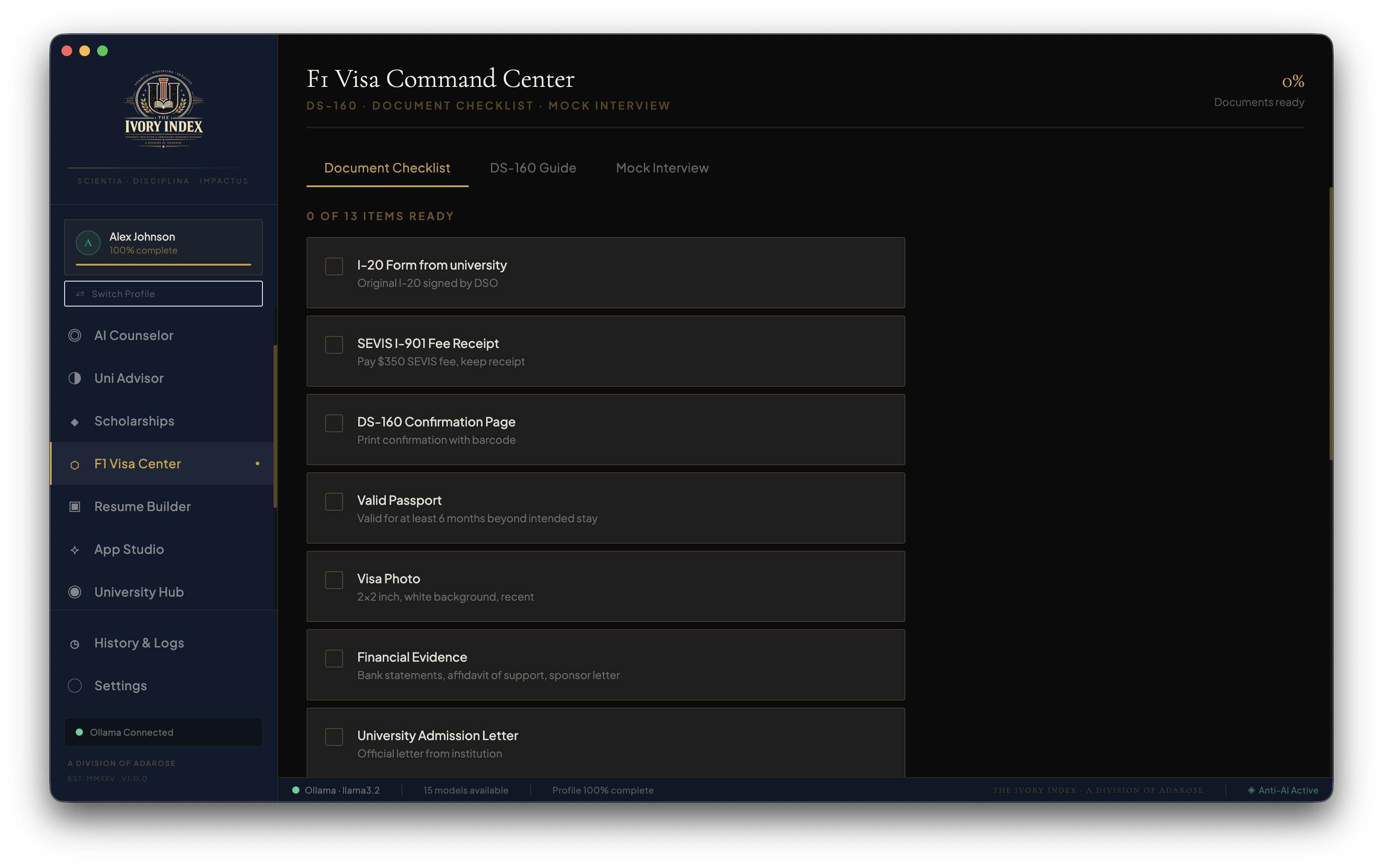
The visa process is a compliance-based verification of student intent and financial capability. Most rejections happen not because of academic credentials, but due to insufficient preparation, scripted answers, or financial documentation inconsistencies [10].

Step 1: The I-20 Document

After you enroll at a university, you must submit financial proof (such as bank statements, loan sanction letters, or a certified net worth statement) verifying you can afford the first year of tuition and living expenses. Once approved, the university issues your **I-20 Form**, which certifies your eligibility to apply for an F-1 Student Visa.

Step 2: SEVIS Database Registration

Your unique SEVIS ID (from your I-20) registers you in the US government tracking system. You must pay the **SEVIS I-901 Fee ($350)**.
Tip: Many international credit cards experience security blocks on the FMJfee portal. If this occurs, print the payment coupon and execute the payment via a Western Union bank transfer to avoid transaction delays.

Step 3: The DS-160 Visa Application

This is your formal, binding application form. You must disclose personal information, travel history, and any social media handle used over the last five years.
DS-160 Rule: Most US consulates require your DS-160 to be signed and submitted at least 48 working hours before your scheduled appointment. No edits can be made once submitted; any typos in your passport number or SEVIS ID require submitting a completely new form.

Step 4: VAC Biometrics & Consulate Interview

You will attend two separate appointments: first, the Visa Application Center (VAC) for digital fingerprinting and photographs (plain white background, strictly no glasses). Second, you will go to the US Consulate/Embassy for your live, face-to-face interview with a consular officer.

4. The Consular Interview: Standard Scenarios

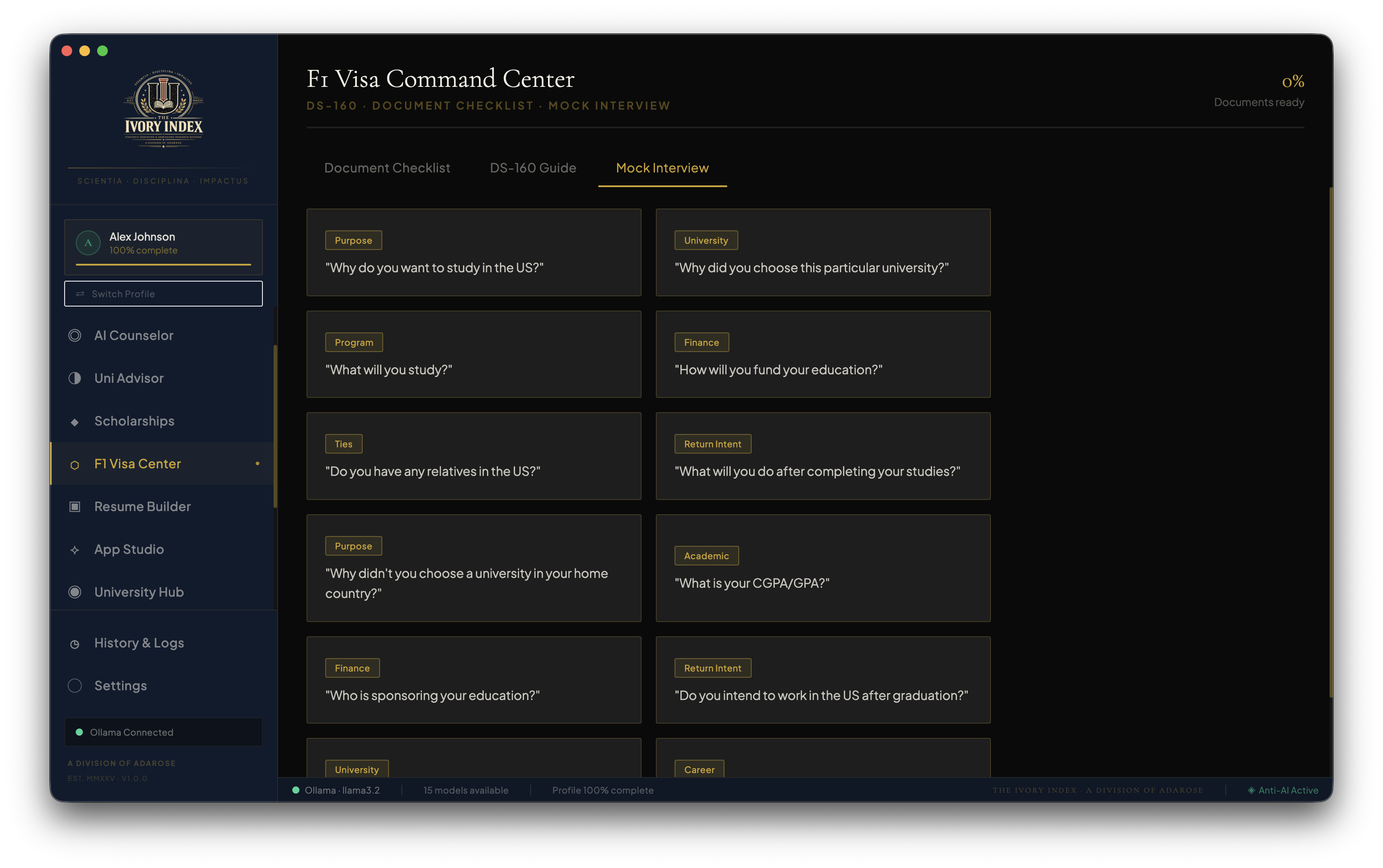
The consular officer has exactly 60 to 90 seconds to make a decision based on three primary metrics: Academic Intent, Financial Capability, and Non-Immigrant Intent (your ties to your home country). Avoid rehearsed scripts.

Scripted, Risky Interview Pattern

Officer: "Why did you choose this university?"

Student: "I chose this university because it has state-of-the-art facilities, world-renowned professors, and an amazing curriculum which will help me grow."

The Red Flag: Generic, memorized response. This response is completely identical to thousands of other applicants and triggers suspicion of non-student intent.

Conversational, Successful Interview Pattern

Officer: "Why did you choose this university?"

Student: "It is one of the few schools offering a specialized undergraduate concentration in autonomous systems. I plan to study under Professor [Name] because his research in computer vision directly intersects with the drone navigation project I designed in high school."

The Strength: Specific, authentic, matches high school accomplishments, proving genuine academic focus.

5. Visa Roadblocks & STEM Security (TAL)

If your visa is not immediately approved, it will encounter one of these administrative states:

  • Section 214(b) Refusal: An outright denial. Usually means the officer was not convinced of your non-immigrant intent (they suspect you plan to permanently immigrate rather than return) or your financial resources appeared inconsistent.
  • Section 221(g) Administrative Processing: Your visa is placed on hold for further document verification or security processing.
  • The Technology Alert List (TAL) Check: If your intended major is in a highly sensitive field—such as Artificial Intelligence, Cybersecurity, Advanced Robotics, Nuclear Physics, or Aerospace Engineering—your application may trigger a security review. This process is procedural but can delay your passport by 4 to 8 weeks; STEM students must book appointments as early as possible [11].

6. CPT, OPT, and US Employment Regulations

The F-1 Student Visa provides two legal mechanisms for gaining practical work experience in the United States:

Curricular Practical Training (CPT)

Work authorization for internships completed during your academic studies. The internship must be directly related to your major and approved by your school's Designated School Official (DSO) before you begin work.

Optional Practical Training (OPT)

Work authorization granted for post-graduation employment in your field. While humanities majors receive 12 months of OPT, graduates with verified STEM degrees are eligible for a 24-month extension, totaling 3 years of work authorization [12].
USCIS Fee Note: To expedite OPT processing times, USCIS Premium Processing is available but the fee has increased to $1,780.

Part V

AI & Modern Admissions

The integration of Large Language Models (LLMs) has fundamentally transformed how applications are written, evaluated, and verified. We are now in the Verification Era of admissions, where committees prioritize authenticity above technical polish.

1. AI Detection & Reader Psychology

Most applicants assume that if their essay bypasses an online AI checker (such as Turnitin or GPTZero), they are safe. This is a critical misunderstanding of how admissions offices operate:

  • Formulaic Writing Over-Detection: Experienced admissions officers read thousands of essays a year. They do not need an automated tool to flag AI. They immediately recognize the standard, highly predictable, and emotionally flat prose that LLMs generate. Phrasings like "In conclusion, it is a complex tapestry of," "beacon of hope," "testament to," or "navigating the intricate labyrinth of" are immediate flags for AI generation.
  • The Threat of Immediate Rejection: Top-tier universities (such as Brown, Yale, and Caltech) have updated their academic integrity policies to explicitly state that using AI to generate application narratives is classified as plagiarism, resulting in immediate disqualification.

2. Authenticity Verification: The Digital Audit

Because of widespread profile inflation and AI-generated text, top-tier admissions departments now execute systematic, random digital audits of competitive folders:

Codebase Auditing

If you claim to have built a machine learning tool, cybersecurity library, or major application, AOs will click your GitHub link. They check your commit history. If a repository has a massive codebase committed in a single day with no developmental history or comments, they flag it as plagiarized or outsourced code.

Professional Footprints

AOs cross-reference your Common App activities against your public LinkedIn profile. Any major discrepancy in dates, titles, or claimed responsibilities between these documents signals profile inflation.

Counselor Verification

If you claim a massive accomplishment—such as raising $10,000 or winning a national competition—but your school counselor's official reference letter does not mention or validate this achievement, the AO will flag it as highly suspicious.

3. Ethical vs. Unethical AI Guidelines

AI is a powerful co-pilot, but it must never be used as a replacement for human thought and reflection:

Ethical Co-Pilot Usage (Highly Encouraged) Unethical Plagiarism (Results in Rejection)
Using AI to organize your messy brainstormed bullet points into a clean, logical outline. Promoting: "Write a 650-word personal statement about my struggle with coding."
Asking AI to identify grammatical errors, passive voice, or overused words in your completed draft. Allowing AI to generate metaphorical descriptions or fabricate personal emotional reflections.
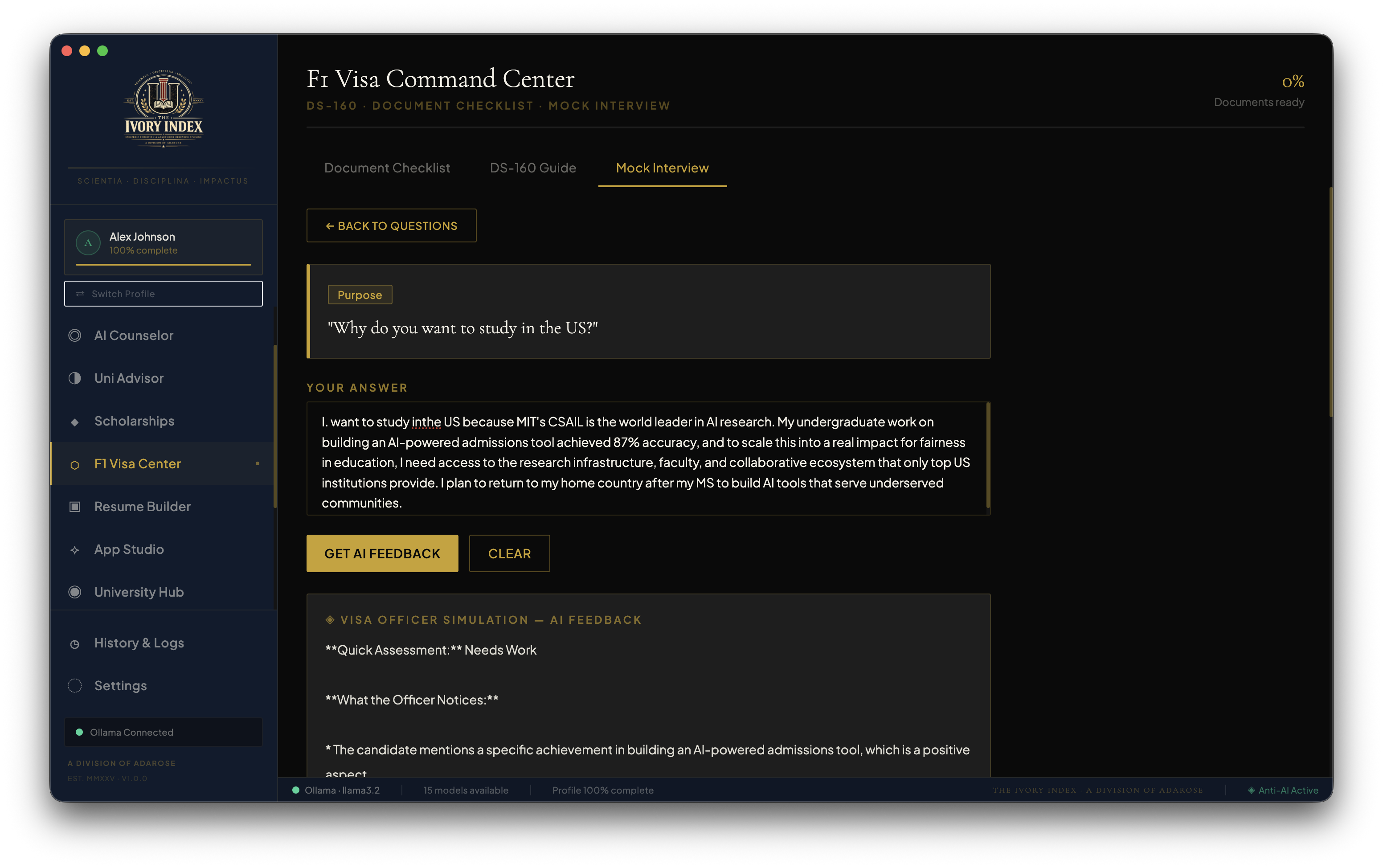
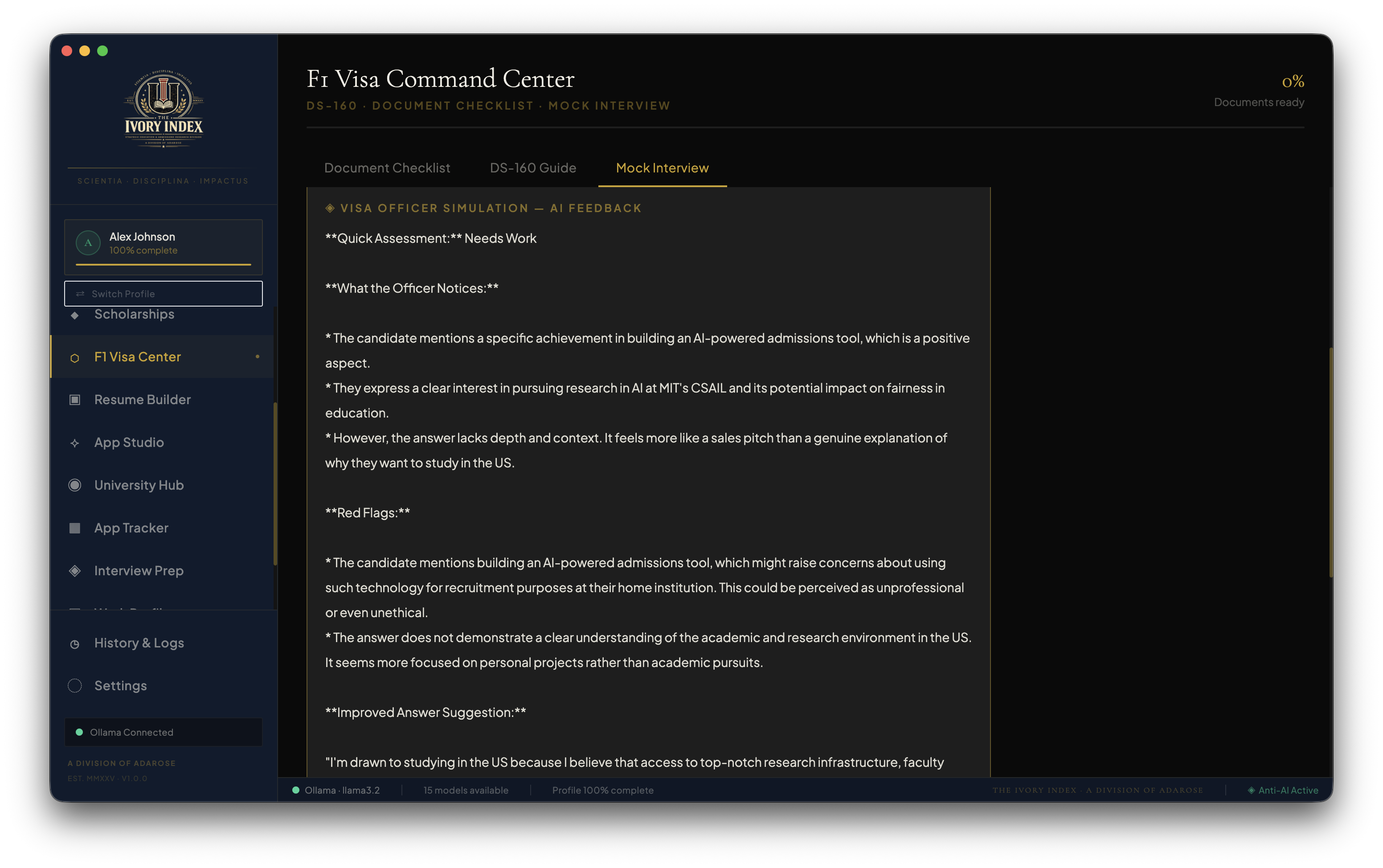
Simulating an alumni mock interview with an interactive LLM to practice clear verbal articulation. Using AI to write custom research abstracts for projects you did not actually execute.

4. Safe & Ethical AI Prompts

Here are highly targeted, functional prompts that you can safely deploy to improve, refine, and organize your applications without compromising authenticity:

PROMPT A: ESSAY OUTLINE STRUCTURING
"I am writing a personal statement about my interest in local historic preservation. Here are my raw, unorganized memories, reflections, and thoughts: [Insert Messy Notes]. Act as an analytical editor. Do not write any sentences or paragraphs for me. Instead, organize my raw thoughts into three potential narrative structures (such as chronological, thematic, or analytical) so I can write the essay myself."
PROMPT B: GRAMMAR & REDUNDANCY AUDIT
"Here is a draft of my college essay: [Insert Draft]. Audit this text strictly for structural mechanics. Identify: 1) Sentences written in passive voice, 2) Repetitive transition phrases, and 3) Areas where my writing is overly verbose or vague. Provide constructive, bulleted feedback on how I can tighten the prose. Do not rewrite the draft for me."
PROMPT C: MOCK INTERVIEW SIMULATION
"Act as an alumni interviewer for Vanderbilt University. I am applying as an environmental science major. Ask me one standard interview question at a time. Wait for my response. After I respond to each question, provide a brief, constructive evaluation of my answer, highlighting areas where I was too vague, generic, or rehearsed, then ask the next question."
PROMPT D: COMMON APP RESUME FORMATTING
"I need to fit this activity description into the Common App Activities section limit of 150 characters: [Insert Description]. Reformat this text into a concise, action-verb-driven fragment. Remove all pronouns, articles, and filler words. Quantify my impact based on these metrics: [Insert Metrics]. Provide 3 different stylistic variations of exactly 150 characters or less."
Part VI

Execution Roadmap

A strategic timeline prevents operational panic and ensures high-quality, authentic execution of your profile and application components.

1. Yearly Operational Focus

The path to competitive US admissions is a long-distance race. Here is your strategic objective for each academic year:

Grade 8 & 9: Exploration and Base Building

Primary Focus: Academic performance and general curiosity exploration. Join various clubs, participate in competitive debates, pick up a sport, and read widely outside your high school syllabus. Focus heavily on getting the highest grades possible—your formal GPA calculation starts in Grade 9.

Grade 10: Narrowing Focus and Diagnostic Testing

Primary Focus: Narrowing down your activities to 2 or 3 core interests. Begin planning your "passion project" or research direction. Take a diagnostic SAT/ACT exam under strict timed conditions to establish your baseline testing score and build a long-term study calendar. Take challenging classes where available.

Grade 11: Rigor Maximization, Testing, and Spike Execution

Primary Focus: The most intense academic and profile year. Take the most challenging courses (AP, IB, or Honors) you can handle without your GPA dropping. Sit for the actual SAT/ACT—ideally, complete all standardized testing by June of Grade 11. Execute your major spike activities: publish your software, lead your organization, compete at national levels, or finalize independent research.

Grade 12: Execution, Essay Writing, and Filing

Primary Focus: Synthesizing your academic and extracurricular profile into the application. Follow a highly structured, operational submission calendar.

2. Grade 12 Operational Submission Timeline

Do not wait until the autumn of Grade 12 to write your essays. Use this structured timeline to prevent high-stress execution mistakes:

Operational Phase Target Date Range Tactical Deliverables & Focus
Phase 1: Foundation May - June (End of Grade 11) Confirm your primary recommenders (2 teachers and 1 counselor). Deliver your Teacher Brag Sheets. Brainstorm 5-10 structural narrative concepts for your Common App Personal Statement.
Phase 2: Drafting July - August Write 3 distinct drafts of your Personal Statement. Draft your initial Common App Activities and Honors descriptions. Shortlist your initial list of 15 candidate universities.
Phase 3: Supplementals September - October Refine your primary essay. Map and write school-specific supplemental essays ("Why Us?" and "Why Major?"). Complete the CSS Profile for financial aid request. Submit Early Action / Early Decision applications by Nov 1.
Phase 4: Finalization November - December Polish all remaining Regular Decision essays. Cross-check your application formatting inside the Common App "Preview" mode. Submit all RD files by Jan 1. Maintain high senior grades (colleges can and do rescind admissions for severe grade drops).

3. Building a Balanced College List

Do not build a list composed entirely of highly selective Reach schools. This is a common strategic mistake that leads to complete rejection. A balanced list consists of 10 to 12 universities distributed across three distinct statistical categories:

Reach Schools (4 - 5 slots)

Acceptance rate is below 15%, OR your GPA/SAT scores fall below their 25th percentile of historical admits. For international applicants, all Ivy League universities, Stanford, MIT, and major need-blind schools must be mathematically treated as Reaches regardless of your profile's strength.

Match / Target Schools (4 slots)

Acceptance rate is between 20% and 45%, and your academic metrics (GPA, test scores) align perfectly with their historical averages (between the 50th and 75th percentiles of past admitted cohorts).

Safety Schools (2 - 3 slots)

Acceptance rate is above 50%, your metrics are comfortably above their 75th percentile of past admitted cohorts, and the school has guaranteed articulation paths, high financial affordability, or rolling admissions. You must be completely willing and happy to enroll in your safeties.

Part VII

Bonus Intelligence & Strategic Databases

This section provides specialized diagnostic frameworks, representative academic case studies, and structured open-source databases to support your application process.

1. Myths vs. Reality

Let's evaluate some of the most common assumptions perpetuated by commercial consulting networks:

Myth A: "You must start an NGO to secure admission into a selective university."

The Reality: Committees are highly skeptical of hollow organizations founded suddenly in Grade 11. They prefer candidates who show consistent participation in established local community groups, work a standard part-time retail or tutoring job, or manage genuine family care responsibilities. Authentic responsibility carries significant institutional weight.

Myth B: "Test-optional policies mean standardized test scores do not affect outcomes."

The Reality: Standardized scores remain a valuable baseline for comparing candidates from diverse national high schools. Successful applicants generally omit scores only if their score falls below the school's historical 25th percentile, or if their classroom marks are exceptionally high and accompanied by a top-tier regional award.

Myth C: "Completing a paid summer program at a prestigious campus guarantees entry."

The Reality: Many pre-college summer programs operate on a fee-for-service model with high acceptance rates. Because these are not academically selective, listing them carries minimal admissions weight. The exceptions are highly selective, merit-based, and fully-funded programs (such as RSI, MIT PRIMES, or TASP) [13].

2. Diagnostic Profile Scoring System

To help you evaluate your current profile objectively before finalizing your college list, use this weighted scorecard (Max Score: 100 points):

Profile Factor Category Metric & Score Boundaries Your Points
Academic Rigor & Grades
(Max 40 Points)
- Top 2% of class in hardest available courses: 40 pts
- Top 5% of class in standard/honors classes: 30 pts
- Top 10% of class or average rigor: 20 pts
- Top 20% or lower academic rigor: 10 pts
[ ]
Standardized Testing
(Max 25 Points)
- SAT 1540+ / ACT 35+: 25 pts
- SAT 1480-1530 / ACT 33-34: 20 pts
- SAT 1400-1470 / ACT 31-32: 15 pts
- Test-Omitted or lower: 10 pts
[ ]
Extracurricular Peak (Spike)
(Max 20 Points)
- Tier 1 Accomplishment (National/International): 20 pts
- Tier 2 Accomplishment (State/Regional): 15 pts
- Tier 3 Accomplishment (School/President): 10 pts
- Tier 4 Accomplishment (Passive member): 5 pts
[ ]
Narrative & Character
(Max 15 Points)
- Highly vulnerable, authentic, non-generic essays & strong letters: 15 pts
- Competent, readable essays but standard topics: 10 pts
- Formulaic, generic, or AI-assisted essays: 3 pts
[ ]
DIAGNOSTIC GUIDELINES:
85 - 100 Points: Competitive candidate for highly selective reaches (Ivies, MIT, Stanford, Top LACs).
70 - 84 Points: Competitive candidate for selective target matches; viable for reaches under early application strategies.
50 - 69 Points: Focus heavily on target matches and safeties; prioritize essay refinement and standardized test preparation.

3. Realistic Student Case Studies

To understand how admissions committees balance academic metrics, financial constraints, and personal narrative, review these five realistic student case studies:

Case Study 1: The CBSE STEM Applicant Needing Aid

Applicant Profile: Aarav (Noida, India). CBSE Board. SAT: 1540 (Math 800, EBRW 740). CBSE Class 11/12 average: 92%. Requiring 95% financial aid to attend university.

The Extracurricular Spike: Rather than joining a standard robotics club, Aarav spent two years building a localized Android application utilizing lightweight convolutional neural networks to detect early leaf rust in local crop varieties. Deployed the app directly with 40 farmers in his family's native village, tracking and documenting a 15% reduction in crop loss over a season.

Narrative & Essay Strategy: Focused his personal statement on the practical friction of translating theoretical computer science into the mud of his uncle's farm—debugging code on cheap smartphones in 42°C heat, showing humility, operational resilience, and high intellectual vitality.

Admissions Committee Decision: ADMITTED to Williams College (with full need-based financial aid package).

Committee Notes: "While Aarav's board percentages are standard for highly selective Indian pools, his genuine local impact and deep technical spike made him an outstanding match for our undergrad research environment. Williams is need-aware for international students, but Aarav's folder was competitive enough to secure one of our reserved international aid allocations."

Case Study 2: The Late-Start Humanities Student

Applicant Profile: Priyam (Kolkata, India). Switched from a science focus to English Literature at the start of Grade 12. Standard ISC board curriculum. No standardized test scores submitted (Test-Optional). Unweighted school average: 88%.

The Extracurricular Spike: Lacking long-term leadership titles, Priyam executed a high-intensity, localized project over four months. He compiled, edited, and published a self-funded physical anthology detailing the disappearing socio-literary history of Kolkata's historic cabin food joints, interviewing elderly waiters and local writers.

Narrative & Essay Strategy: Wrote a highly reflective, beautifully phrased personal statement analyzing the sensory intersection of culinary literature, colonial memory, and working-class oral histories, proving a mature, authentic, and independent writing voice.

Admissions Committee Decision: ADMITTED to Kenyon College (via Early Decision II, with partial merit-scholarship).

Committee Notes: "Priyam started his profile extremely late, which usually presents a major disadvantage. However, his self-guided literature project was highly aligned with Kenyon's rigorous writing culture. Applying via ED II helped mitigate concerns about his test-optional status."

Case Study 3: The Average Grades but Elite Essays Applicant

Applicant Profile: Chloe (Chicago, US). High school GPA dipped to 3.4 unweighted in Grade 11 due to a severe, documented case of chronic Lyme disease. ACT score: 32.

The Extracurricular Spike: Confined to her home during her illness, Chloe learned to restore obsolete, analog cassette-tape decks. She sourced non-functional hardware from local thrift stores, cleaned internal capstans, calibrated transport belts, and restored historical tapes for local community archives.

Narrative & Essay Strategy: Used her personal statement to detail the meticulous process of analog calibration. Rather than focusing on the self-pity of illness, she framed tape restoration as a metaphor for slow, methodical recovery—showing extreme patience, technical curiosity, and high self-reflection. Her counselor contextualized the GPA dip in the official reference letter.

Admissions Committee Decision: ADMITTED to Tufts University (Regular Decision).

Committee Notes: "Chloe's GPA dip in Grade 11 was a major concern, but the counselor's letter explained the medical context. Her personal essay was outstanding—mature, highly creative, and showed an independent intellectual focus that immediately stood out from the thousands of highly-polished, formulaic student profiles we review."

Case Study 4: The Olympiad-Heavy Applicant

Applicant Profile: Viktor (Sofia, Bulgaria). National Physics Olympiad Winner. Bulgarian National High School GPA: 6.00/6.00 (Perfect). SAT: 1590 (Math 800, EBRW 790). Highly quiet and struggles with expressive writing.

The Extracurricular Spike: Flawless academic and quantitative milestones. Viktor spent his high school career focusing entirely on the physics olympiad track. He had minimal leadership titles, played no competitive sports, and had very basic school club participation.

Narrative & Essay Strategy: Avoided trying to sound like a creative writer or social advocate. He wrote a simple, direct, and highly logical essay detailing his deep focus on solving a specific, unsolved classical mechanics challenge on his national exams. This proved absolute academic focus.

Admissions Committee Decision: ADMITTED to Caltech & MIT (Regular Decision).

Committee Notes: "Viktor is a highly specialized applicant. He didn't have broad leadership or diverse extracurriculars, but Caltech and MIT are highly selective research hubs where elite quantitative spikes are highly valued. His physics accomplishments verified his academic potential beyond any doubt."

Case Study 5: The Low-Income Community College Transfer

Applicant Profile: Mateo (Los Angeles, US). First-generation college student. Family income below federal poverty line. Attended Santa Monica College (Community College) for two years. GPA: 3.95 out of 4.0. No standardized test scores submitted.

The Extracurricular Spike: Managed a standard, 25-hour-a-week paid job as an assistant inventory coordinator in a regional grocery store to help pay family rent. Volunteered 3 hours a week translating municipal tax documents into Spanish for local elderly residents at his neighborhood library.

Narrative & Essay Strategy: Wrote a highly grounded, clear transfer essay focusing on his work ethic, explaining how he managed logistics and inventory under pressure in the grocery store. Connected this practical experience directly to his academic interest in supply chain economics.

Admissions Committee Decision: ADMITTED to UCLA (Transfer admission via TAP/IGETC Articulation Agreement, with full tuition covered by Blue & Gold Opportunity Plan).

Committee Notes: "Mateo utilized the California public transfer pathway with outstanding academic performance. His profile did not have flashy, high-cost activities, but his retail job and community service proved high responsibility, resilience, and maturity—exactly the qualities that succeed on our campus."

4. "Starting Late" Operational Contingency

If you discover the US admissions ecosystem late—such as in the summer before Grade 12—focus on these recovery steps:

  1. Drop Standardized Testing if below threshold: If your timed diagnostic SAT score is below 1350 and you have limited preparation time, pivot immediately to the **Test-Optional** pathway. Focus your remaining energy on maintaining your transcript GPA and drafting strong essays.
  2. Consolidate Your Activities: Select the top 4 activities you have already completed and build your application around them. Frame these achievements by highlighting their specific, quantified outcomes rather than simply listing titles.
  3. Execute a Strategic Early Decision I Plan: Target a private Match university that has a historical Early Decision acceptance rate significantly higher than its Regular Decision rate, maximizing your admissions probability.

5. The Low-Budget / Zero-Consultant Pathway

You do not need to pay $10,000 to an admissions consultant. Everything required to secure admission to a premier US university is completely free, open-source, and accessible to anyone with an internet connection:

  • Academic Prep: Use **Khan Academy** (the official, free partner of the College Board) to prepare for the Digital SAT. They provide complete adaptive diagnostics and thousands of practice problems.
  • Essay Inspiration: Read the official "Essays That Worked" repositories published directly by universities (such as Johns Hopkins, Hamilton College, and Tufts). These show the exact structural patterns, vulnerability levels, and writing styles favored by committees.
  • Community & Peer Advice: Use communities like **Reddit's r/ApplyingToCollege** to download free planning spreadsheets, track application timelines, and review past applicant outcomes. Avoid the toxic comparison threads; focus purely on the resource wikis.
  • Sovereign Peer Networks: Build a local group of 3 trusted, motivated peers. Read each other's essay drafts strictly to evaluate if the writing "sounds like you." Your peers know your authentic voice better than any high-paid agency consultant.
“The frightened mind sees a maze; the informed mind begins noticing doors.”